Think & Discuss
Quick Check
Inquiry Task
Reference dimensions include: population size (about 500 million vs over 8 billion), energy base (human and animal power vs fossil fuels/electricity/nuclear energy), city scale and speed of transport and communication (small towns with slow transmission vs megacities with global real-time communication), production and technological levels, and the speed of information transmission.
The gap represents a leap in power and capability, which does not automatically equate to happiness, justice, or ecological sustainability. Judging happiness requires considering specific indicators and evidence such as distribution, health, social relationships, and environmental quality. Possible counterexamples: pollution from industrialization, growing inequality, psychological stress, etc.
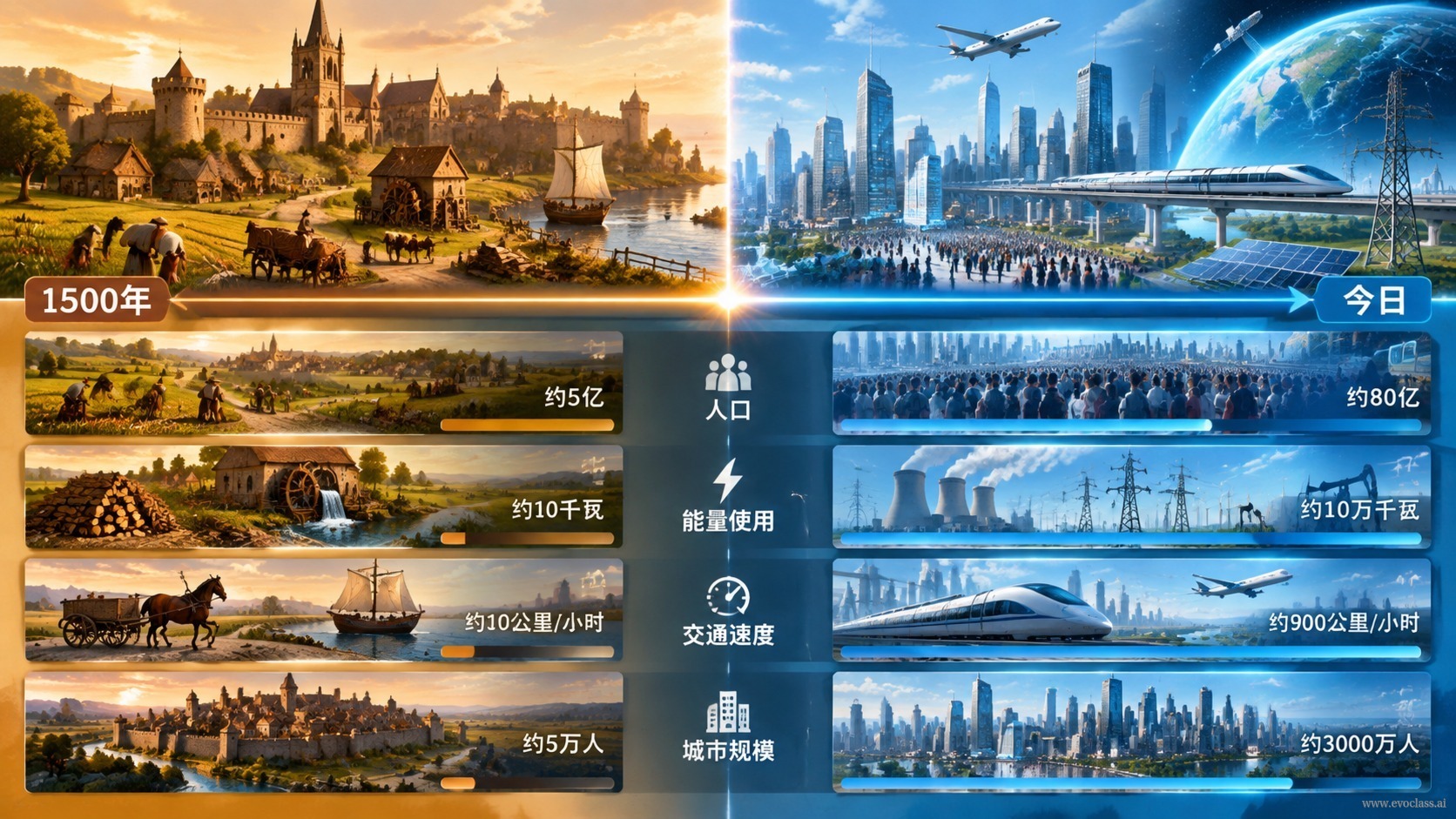
Using around 1500 as a mirror makes it clearer that today's civilizational "gap" is not a smooth slope but a nonlinear leap in power. Global population was about 500 million then, and now exceeds 8 billion. The energy base has shifted from human and animal power and simple machinery to fossil fuels, electricity, and nuclear energy. Cities have gone from small local towns to megacities, and information transmission has gone from days, weeks, and months to global real-time communication and air travel.
The following table places the two eras side by side across several dimensions to help build a macro-level comparison:
| Dimension | Around 1500 | Today |
|---|---|---|
| Population | About 500 million | Over 8 billion |
| Energy base | Human and animal power, simple machinery | Fossil fuels, electricity, nuclear energy |
| Production & Technology | Limited by the organic economy, easily disrupted by poor harvests, plagues, and wars | After the Scientific Revolution, knowledge production shifted toward observation, mathematization, and acquiring new capabilities |
| Cities & Time-Space | Small cities, slow transport and communication | Megacities, global real-time communication and air travel |
The key to the gap lies not in a sudden change in biological brainpower, but in the transformation of knowledge systems. Three features distinguish modern science from pre-modern knowledge systems:Admitting ignorance,Centering on observation and mathematics,Pursuing new capabilities. Take Newton as an example: he demonstrated that the language in which the book of nature is written is mathematics. Later scholars tried to write biology, economics, and psychology as simple formulas too, but found these fields far too complex. So mathematics developed a new branch: statistics.
In 1744, Scottish Presbyterian ministers Alexander Webster and Robert Wallace set out to establish a life insurance fund for the widows and orphans of clergy. They did not pray to God or look for answers in the Bible. Instead, they contacted Colin Maclaurin, a mathematics professor at the University of Edinburgh, collected data on the ages at which people died, and used the law of large numbers proposed by Jacob Bernoulli, along with the statistical tables previously published by Edmond Halley, to estimate how many ministers died each year, how many widows and orphans they left behind, and how long widows would live after their husbands' deaths. Based on these calculations, they projected that by 1765 the fund's total capital would be £58,348. It later turned out to be £58,347—just £1 less than the prediction. This case shows how probabilistic calculation became the foundation of actuarial science, insurance, and demography, and illustrates how mathematization and probabilistic thinking transformed knowledge production.
A feedback loop forms among science, politics, and economics: scientific research depends on external funding, and in turn strengthens a nation's military, economic, and organizational capabilities. Capitalism and imperial expansion provide funding and demand for science, while science provides them with new tools and power. This loop is not one-directional but mutually reinforcing.
First, the comparison is at a macro scale. The world of 1500 was not homogeneous; development levels varied greatly across regions. Today's gap is also highly uneven within individual societies—within the same city, the energy, information, and organizational networks different groups can mobilize may be worlds apart.
Second, the human brain accounts for about 2–3% of body weight and consumes about 25% of resting energy, compared with about 8% in other apes; a large brain once increased foraging burdens and came with muscle degeneration. But the gap from 1500 to the present is not due to a sudden change in brain size—it stems from the reorganization of external knowledge, institutions, and energy systems.
Finally, the Scientific Revolution brought a leap in power, but this does not automatically equate to happiness, justice, or ecological sustainability. Increased power and value judgments are questions at two different levels. Some scholars attribute this leap to the Scientific Revolution and its feedback loops; this is one interpretive framework for history that requires discussion in light of more evidence.
Timeline comparing population, energy use, transport speed, and city scale between 1500 and todayObserve the timeline comparing population, energy use, transport speed, and city scale between 1500 and today, and think about how it relates to "small city scale and slow transport and communication around 1500."